Quick answers
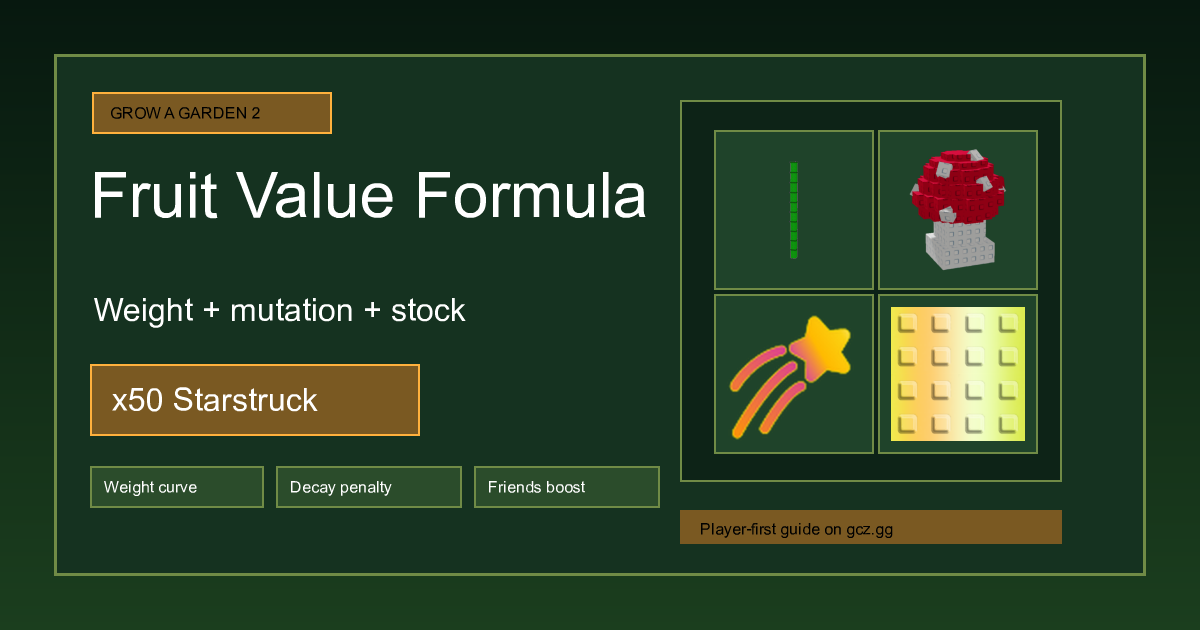
- Fruit value is not random. GAG2 starts with a crop base value, then applies fruit weight, mutation, Fruit Stock, decay and friend boosts.
- Fruit weight matters because value scales on a curve, not as a flat bonus. Heavy fruit can jump in price quickly.
- Single-harvest crops do not always get the full mutation benefit, so do not compare them directly with repeat harvest crops.
Why your fruit sells for a different price
If two Bamboo fruits look close in size but sell for very different amounts, the price difference is usually coming from weight or mutation. The game does not simply read the crop name and pay one fixed number. It builds the sell price step by step.
The practical version is simple: base value gives the fruit a starting point, weight pushes that value up, mutations multiply it, Fruit Stock can adjust the market number, decay can pull the price down, and friends can push it back up. That is why a small normal fruit and a heavy Starstruck fruit can feel like they are from two different games.
The player-friendly formula
Think of the formula like this: base value x weight score x mutation multiplier x Fruit Stock x decay penalty x friend boost. The final number is floored, so tiny decimals do not show up in the sell result.
Base value comes from the crop. Weight score is the big one for most serious sales. The default weight exponent is 2.65, while Mushroom and Bamboo use lower special exponents. That still means weight matters a lot; it just means those crops have their own curve.
Mutation is applied after the weight part. Gold, Rainbow, Electric, Starstruck, Ignited and Bloodlit can completely change whether a fruit is worth selling now or saving for a better stock window. If the fruit has no visible mutation, keep the calculator on None.
Weight is powerful, but not magic
Weight is not a clean one-to-one multiplier. GAG2 uses a curve and then slows the tail after a knee point. In normal player terms: bigger fruit is usually better, but the game has guardrails so size does not scale forever at the same speed.
This matters most when you use sprinklers or other SizeLuck sources. A bigger roll can be huge, but you should still check the final value with the Crop Value Calculator instead of guessing from the model size alone.
Mutation is only real when the fruit has it
Weather can create opportunities, but active weather does not mean every fruit should be priced as mutated. If Lightning is active, you still only use Electric pricing after the fruit actually shows that state. The same idea applies to Rainbow, Frozen, Starstruck, Aurora and other event-linked outcomes.
For single-harvest crops, be extra careful. Their mutation bonus is scaled down compared with repeat harvest logic, so a high multiplier does not always behave the way a new player expects. This is one of the easiest ways to overestimate profit.
Decay and friends are easy to forget
Decay can remove a large part of the final value. If fruit sits too long, the game can punish up to 80% of the price. That makes timing important, especially when you are waiting for a stock window or moving around the garden.
Friends work in the other direction. Each friend adds a boost, so selling with friends online can be better than selling alone. The effect is easy to miss because it feels like a social bonus, but it belongs in the same value formula.
Best way to use this
- Use the calculator after you know the fruit weight.
- Only choose a mutation after the fruit visibly has it.
- Use Fruit Stock when you are checking whether to sell now or wait.
- Keep decay low before selling expensive mutated fruit.
- Compare single-harvest crops against seed cost, not only sell price.
Common mistakes
- Pricing a fruit as Rainbow just because Rainbow weather happened.
- Ignoring decay on expensive fruit.
- Assuming plant height and fruit weight are the same thing.
- Comparing single-harvest and multi-harvest crops without accounting for repeat income.
- Using base sell value as if it were the final sell value.
Related tools
Open the Crop Value Calculator for the full formula. Use Mutations when you need multiplier sources, and use Seeds when you need base values and harvest type.